
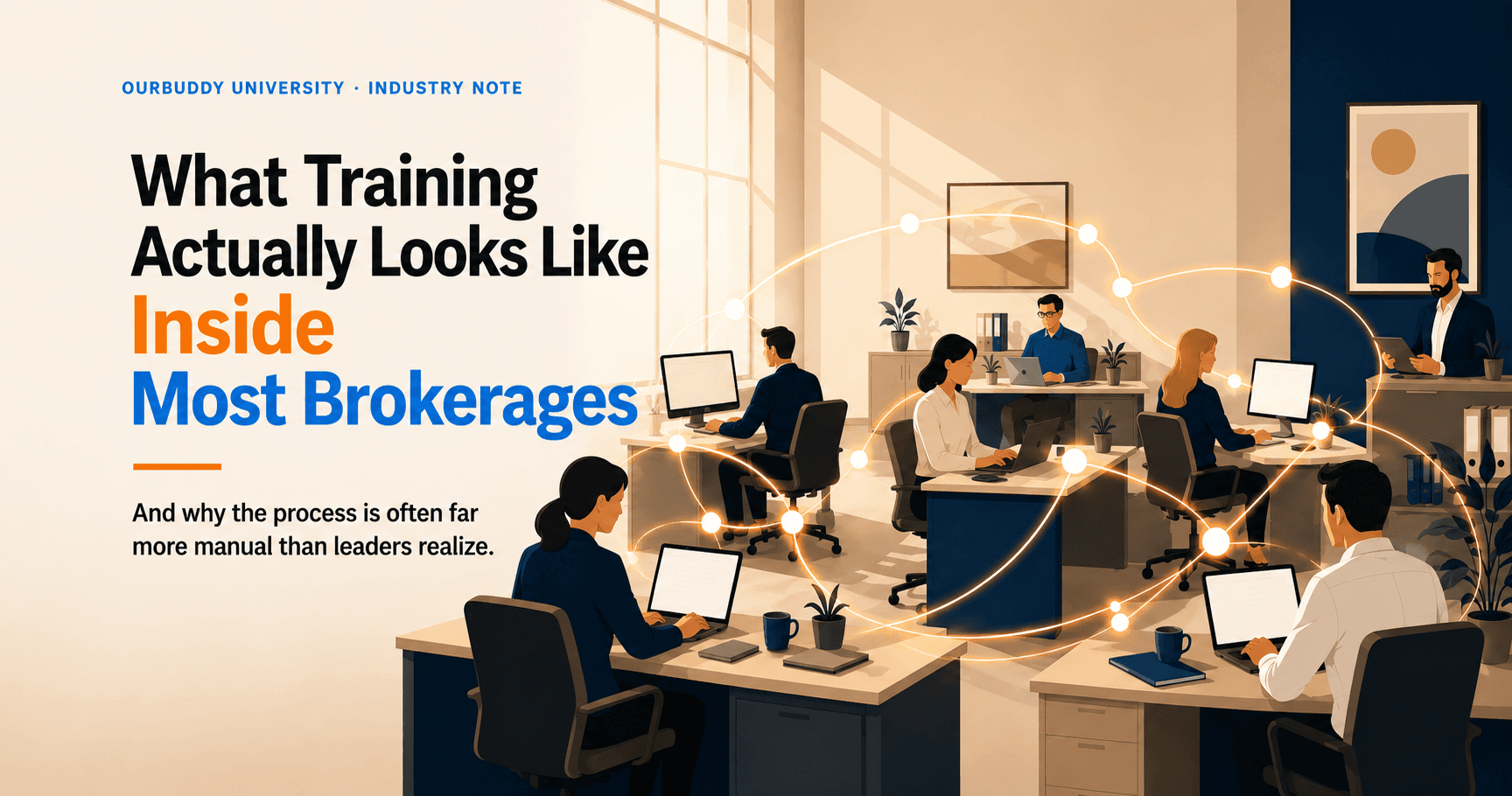
And why the process is often far more manual than leaders realize.
A carrier updates an endorsement on a Tuesday. By Wednesday, a manager has been asked to make sure the commercial team understands what changed. Simple enough, on paper. Except the details sit in a PDF, a recorded call, and the head of one senior broker who is booked solid until next week. Before a single person can be trained on the change, someone has to track it down, make sense of it, write it up, and find time with the one person who actually knows it.
The training has not started yet. The work already has.
That gap, between the moment training is needed and the moment it actually changes how someone works, is where the real story sits. And it looks far more manual than most leaders realize. What training actually looks like inside most brokerages is not the tidy version on the org chart. It is this one, the one you only see when you follow the process from beginning to end.
In almost every brokerage, training exists. People are onboarded, updates get communicated, knowledge gets shared, and managers and trainers put real effort into helping teams learn and perform. From a distance the system looks functional. But zoom in and follow the whole thing, from the first request to the moment knowledge actually changes how someone works, and a different picture tends to emerge. Not because anyone is doing it wrong. Because many brokerages are still running training through a process that was never designed to scale. Across the brokerages we have walked this through with, the same pattern shows up again and again.
How training actually begins
Most training does not start with a strategic calendar. It starts with a trigger. A new hire joins, a process changes, a compliance requirement lands, a carrier introduces something new, or a manager spots a gap. Someone says we should build training on this, and the work begins there.
The first challenge is rarely delivery. It is finding the knowledge in the first place. Whoever owns the training has to gather it from wherever it happens to live: SOPs, carrier documents, recordings, internal notes, old emails, and the heads of the few people who actually know the answer. The information exists. It is just scattered across a dozen places and a handful of people, and collecting it can quietly consume days or weeks before a single thing has been built.
Turning scattered knowledge into something teachable
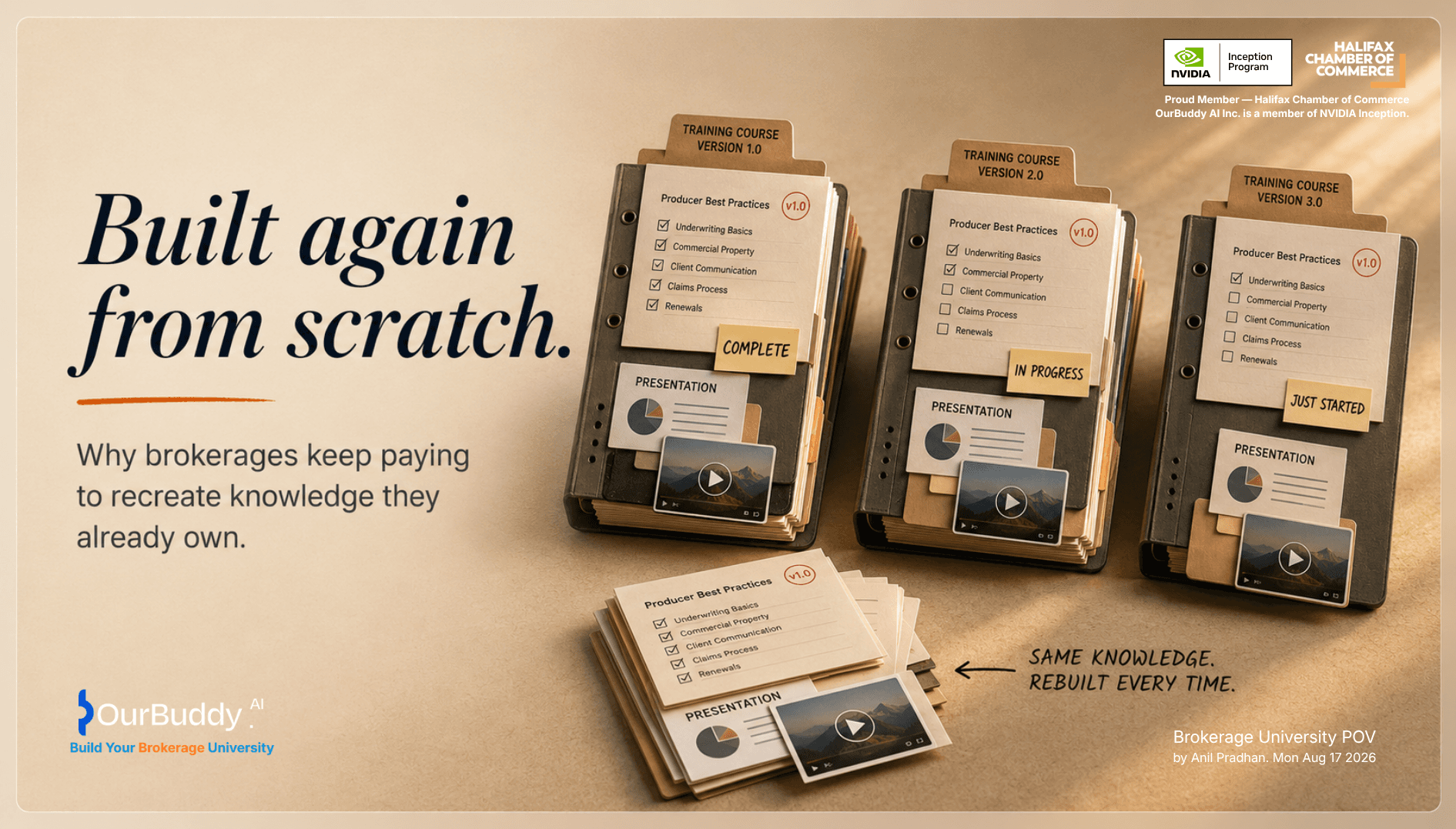
Once the material is gathered, someone has to make sense of it. Review it, organize it, prioritize it, and translate it into something another person can actually learn from. In one brokerage that means slide decks. In another it means written guides, recorded videos, or a live session. The format changes from topic to topic. The effort does not. And because the work is still almost entirely manual, every new topic effectively becomes a new project, started close to scratch.
Underneath all of it sits a dependency. The people who know the material best are usually the busiest people in the building. Senior brokers, managers, technical specialists. Their knowledge is exactly what the training needs, but training is rarely their actual job. So the process waits on them. Reviews slip, questions sit unanswered, and what looked like a straightforward initiative stretches across weeks or months.
Getting people through it, and knowing whether it worked
When the content is finally ready, the next challenge begins: getting people through it. Schedules get coordinated, sessions booked, invitations sent, attendance tracked, participation encouraged, follow-ups chased. Depending on the brokerage this runs on spreadsheets, calendar invites, QR-code sign-ins, and manual sign-offs. None of it is wrong. All of it is labor, and every step adds a little more friction.
Then comes the simple question: how did it go? The answer usually comes from attendance, participation, a survey, and a manager's read. Those inputs are useful, but they rarely show operational readiness. Someone can attend a session, take part, and even enjoy it, and still not carry that knowledge into how they handle the next file. That gap, between training activity and training effectiveness, is where a lot of brokerages quietly get stuck.
One leader we shared this with, who runs a frontline client-care team and answers for how that work shows up for the client, put it more plainly than we had. Training is not the same as capability, and a single session builds neither. Capability comes from reinforcement and coaching over time, with someone accountable for it. The frontline leader is usually where that happens, or where it quietly does not. A standard gets explained in a session, but it turns into behaviour on the floor, in the small corrections a manager makes day to day. When that reinforcement is left to chance, the training technically happened and almost nothing changed.
What happens when the business grows
Taken one at a time, none of these steps looks unreasonable. Most brokerages have run this way for years. The strain shows up when the business grows. More hires, more branches, more updates, more specialization. The same process that worked for twenty people is suddenly asked to carry two hundred, or six hundred, or a thousand, and the cracks start to show. Not because anyone stopped caring. Because the process itself was never built to scale.
When leaders look at training, they usually look at content. Do we have enough courses. Do we need more documentation. Those questions matter, but there is a more important one underneath them. How much effort does it currently take for knowledge to move from one person's head into consistent behavior across the whole organization? That effort is where the friction lives. And that friction, accumulated quietly across every step above, is what eventually becomes training drag.
Why no one sees the full cost
Part of why this stays invisible is that the process never lives in one place. Pieces of it sit with managers, trainers, operations, subject-matter experts, and HR. Because the responsibility is distributed, so is the cost.
Everyone sees their portion. Few see the entire system.
That is why training so often feels slower, heavier, and more expensive than expected, without anyone being able to point to a single cause.
What it looks like when it works
It is worth picturing the other version, even briefly. In the brokerages where this works well, knowledge gets captured once and reused instead of rebuilt every time. The senior people spend their hours refining what good looks like rather than repeating it. And leadership can actually see where readiness is strong and where it is drifting, early, instead of learning about it after a mistake. The difference is not more training. It is a process built to carry knowledge at the scale the business has actually reached.
Closing
Most brokerages already have people who care about training, knowledge worth sharing, and training activity happening every week. The real question is whether the process that moves that knowledge is still fit for the size and complexity of the organization today. When it stays dependent on manual collection, manual creation, manual coordination, and manual reinforcement, friction builds in the background until it becomes a cost nobody chose and few can see.
If you are curious how much of that hidden drag may already sit inside your own training process, you can put a directional number to it here:
Run the Training Drag Diagnostic to estimate what your current training model may already be costing your brokerage.
With thanks
With thanks to the brokerage owners, operators, and frontline leaders across Canada whose conversations shaped this piece. Particular thanks to Irfan Suleman for sharpening the point about where learning actually becomes behaviour.
Author bio: Anil Pradhan is a Halifax-based P&C broker turned training and operations leader, and co-founder of OurBuddy.ai. He works with Canadian brokerages on building internal Brokerage University systems to improve role readiness, consistency, and knowledge transfer across teams and locations.