
How duplicated effort quietly turns knowledge you already own into work you keep paying for.
Brokerage University POV · by Anil Pradhan · Aug 10, 2026
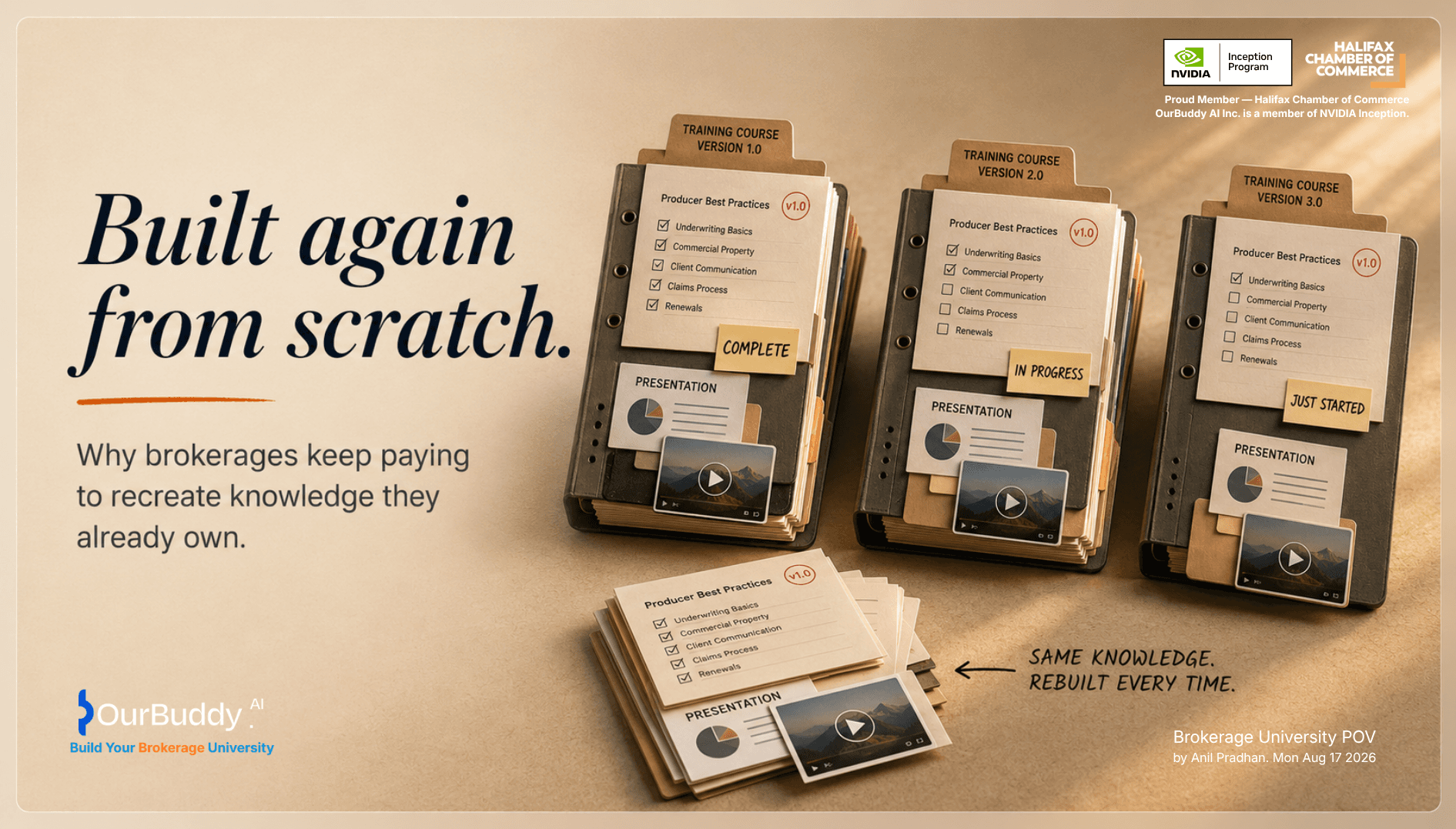
A manager decides the onboarding needs fixing. New producers keep hitting the same gaps, so she blocks a few afternoons, pulls the slide deck someone built two years ago, tracks down the updated wordings, asks a senior broker to walk her through the commercial process again, and rebuilds the module.
It is good work, and it takes weeks.
Almost everything she assembled already existed somewhere in the building: a deck, an email thread, a recording, a document someone wrote and forgot.
The brokerage did not lack the knowledge. It paid, again, to put it back together.
Article 7 was about the people your knowledge lives in: the experienced few everyone walks over to ask. This is what happens to that knowledge the moment someone needs to teach it.
A new hire starts. A carrier changes a form. Someone decides the onboarding is stale. Each creates a training need, and each tends to begin the same way: from close to zero. Not because the knowledge is missing, but because it is scattered across a dozen places and half a dozen heads, in no form the next person can readily use.
Why the same work keeps coming back
A few ordinary things cause this. None of them is anyone's fault.
The knowledge is fragmented. What a producer needs to learn about a commercial class sits partly in a senior broker's head, partly in an old email, partly in a carrier's PDF, and partly in the way it actually gets done here, which may be written down nowhere.
The source material is scattered. Decks sit on someone's drive. A recording lives in a lunch-and-learn folder. A document is three versions deep. A Teams thread has the real answer buried in it. Finding the existing version can take longer than making a new one, so people make a new one.
The ownership changes. Whoever built the last version leaves for another shop and takes the context with them. What they created may still exist, but nobody trusts it or knows where it lives, so the next person starts fresh.
And training gets made as a project, not an asset. Someone needs it, so someone builds it for that need and that month. When the next need appears, the last build is not ready to extend. It is in a folder nobody opens.
The loop nobody names
Put those conditions together and the same loop runs repeatedly. Someone collects the knowledge. A senior person reviews it for accuracy. Somebody turns it into a document or a deck. It gets shaped into something teachable and delivered.
Then the next need appears, and the loop starts again at collection, as if the earlier work never happened.
Ask two branches how they onboard a new commercial producer and you may hear two different answers, both built from scratch and both drawing on the same underlying knowledge. The knowledge was the same. The work of turning it into training happened twice.
What the duplication actually costs
The cost is easy to miss because every rebuild looks like progress. Something did get created at the end. The problem is that much of the work required to create it had already been done before.
The bill comes due in three places.
1. Repeated expert time
The rebuild pulls senior people back in, often the same experts from Article 7, to explain and review the same material one more time. Their knowledge remains essential. The recurring cost comes from having to recover it again for every new build.
2. Version and standards drift
Knowledge reassembled from scratch comes out a little differently each time. Two teams can learn two versions of the same process, not because anyone intended to create inconsistency, but because each version was reconstructed from different fragments.
3. Failure to create a reusable organizational asset
The brokerage owns the underlying expertise, but not yet in a form it can reliably find, govern, update, and extend. It keeps paying the reconstruction cost on each new occasion instead of allowing one piece of work to strengthen the next.
Across multiple conversations, brokerage leaders have described rebuilding versions of the same training more than once. Each rebuild felt like new progress. Much of it was reconstruction.
Why leaders do not see it
This cost never appears where a COO or owner normally looks. There is no line item for rebuilding what the brokerage already had.
The finished module is visible. The weeks spent reassembling it are not. The fact that much of that time went into recovering knowledge the brokerage already owned is more invisible still.
If anything, the work reads as diligence: We keep our training current. We put real work into it. Both are true. But a meaningful share of that effort may be spent recreating rather than creating.
What it looks like when the loop stops repeating
The alternative is not exotic. Senior people remain the source. What changes is that their expertise is turned into a reusable, governed starting point: captured in their own words, reviewed for accuracy, assigned clear ownership, and updated as the work changes.
When a form changes, someone updates the trusted source instead of starting a new deck. When a new producer arrives, the module is already there and current because the last person's work became an asset the next person could extend, not a project that ended in a folder.
The knowledge does not stop coming from people. It stops having to be reassembled from scratch every time someone needs it.
Closing
Rebuilding training is not a sign of a careless brokerage. It is the natural result of knowledge that lives in people and material that lives everywhere.
But it is a recurring cost, and it hides precisely because each rebuild produces something real at the end.
The question worth sitting with is not whether your team can build good training. Clearly it can.
It is how many times it has built the same thing.
Rebuilding is only one form of hidden Training Drag. If you want a directional estimate of what the wider training model may already be costing your brokerage, you can put a number to it here:
With thanks
With thanks to the brokerage owners, operators, and frontline leaders across Canada whose conversations continue to shape this series, and in particular to those who described rebuilding the same training more than once, long before anyone gave the pattern a name.
Anil Pradhan is a Halifax-based P&C broker turned training and operations leader, and co-founder of OurBuddy.ai. He works with Canadian brokerages on building internal Brokerage University systems to improve role readiness, consistency, and knowledge transfer across teams and locations.