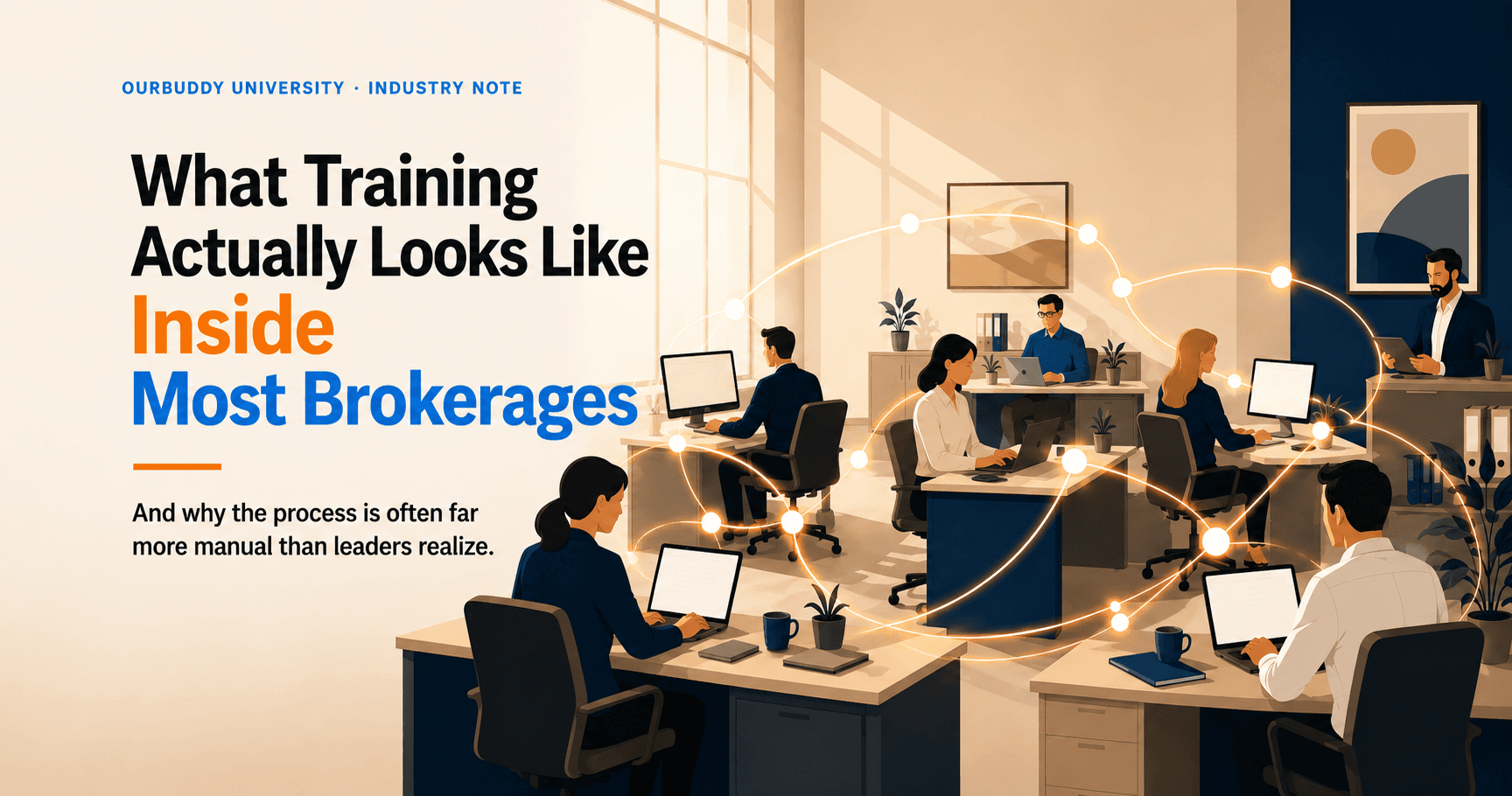

Why many brokerages are still caught between people-dependent training and passive content libraries.
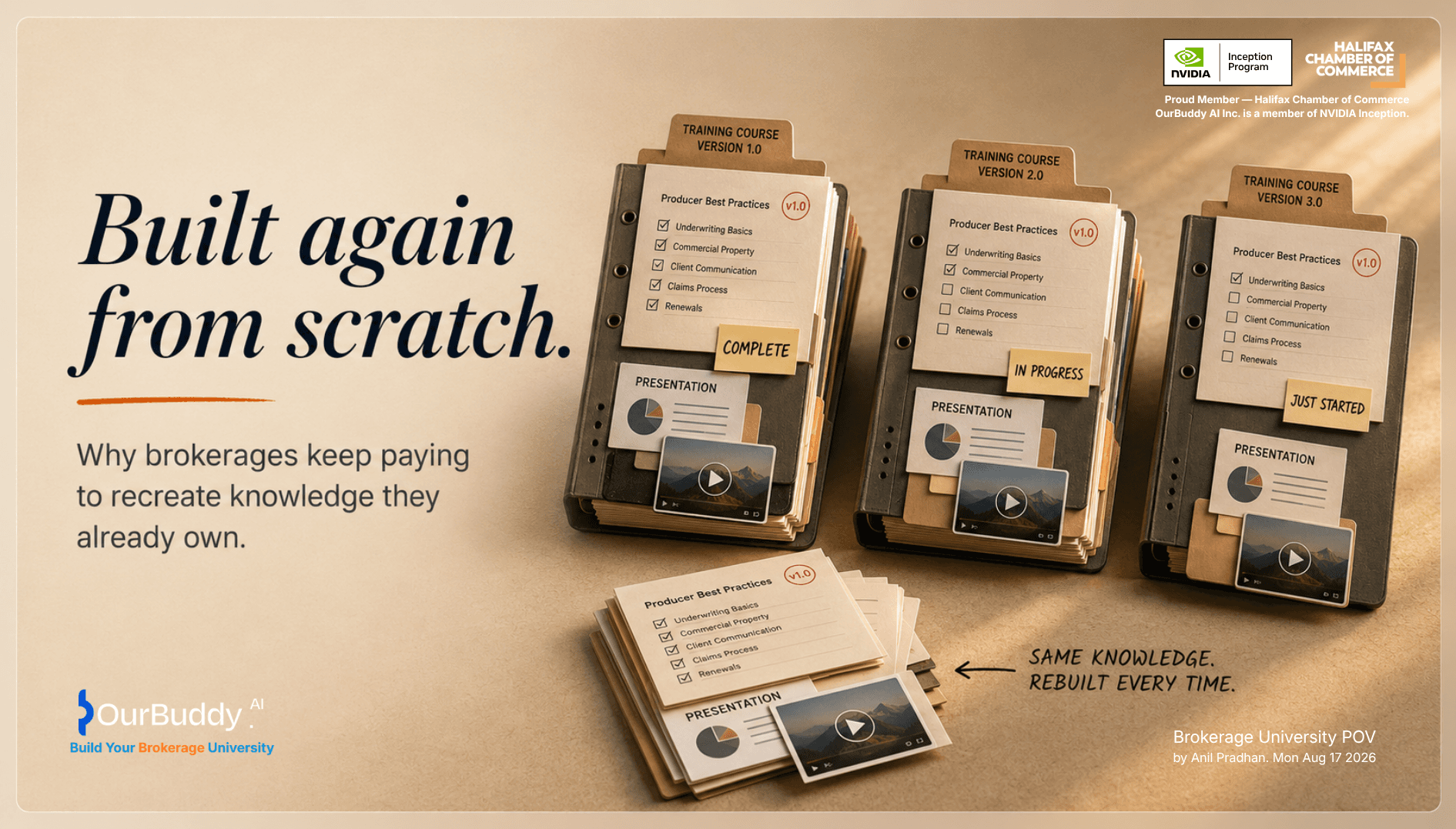
In most Canadian P&C brokerages, training already exists.
There are trainers. There are onboarding processes. There are documents, SOPs, recordings, shared folders, webinars, and LMS platforms. There are people investing real effort to help teams learn, improve, and stay aligned.
And yet, despite all of that activity, many brokerages still experience the same recurring problems.
New hires take longer than expected to become fully independent. Senior staff continue answering the same questions repeatedly. Training updates take too long to build and distribute. Consistency varies between teams and branches. Leadership struggles to clearly see who is actually ready and who is quietly falling behind.
At first glance, these may seem like isolated operational frustrations.
But underneath them is often a deeper structural issue.
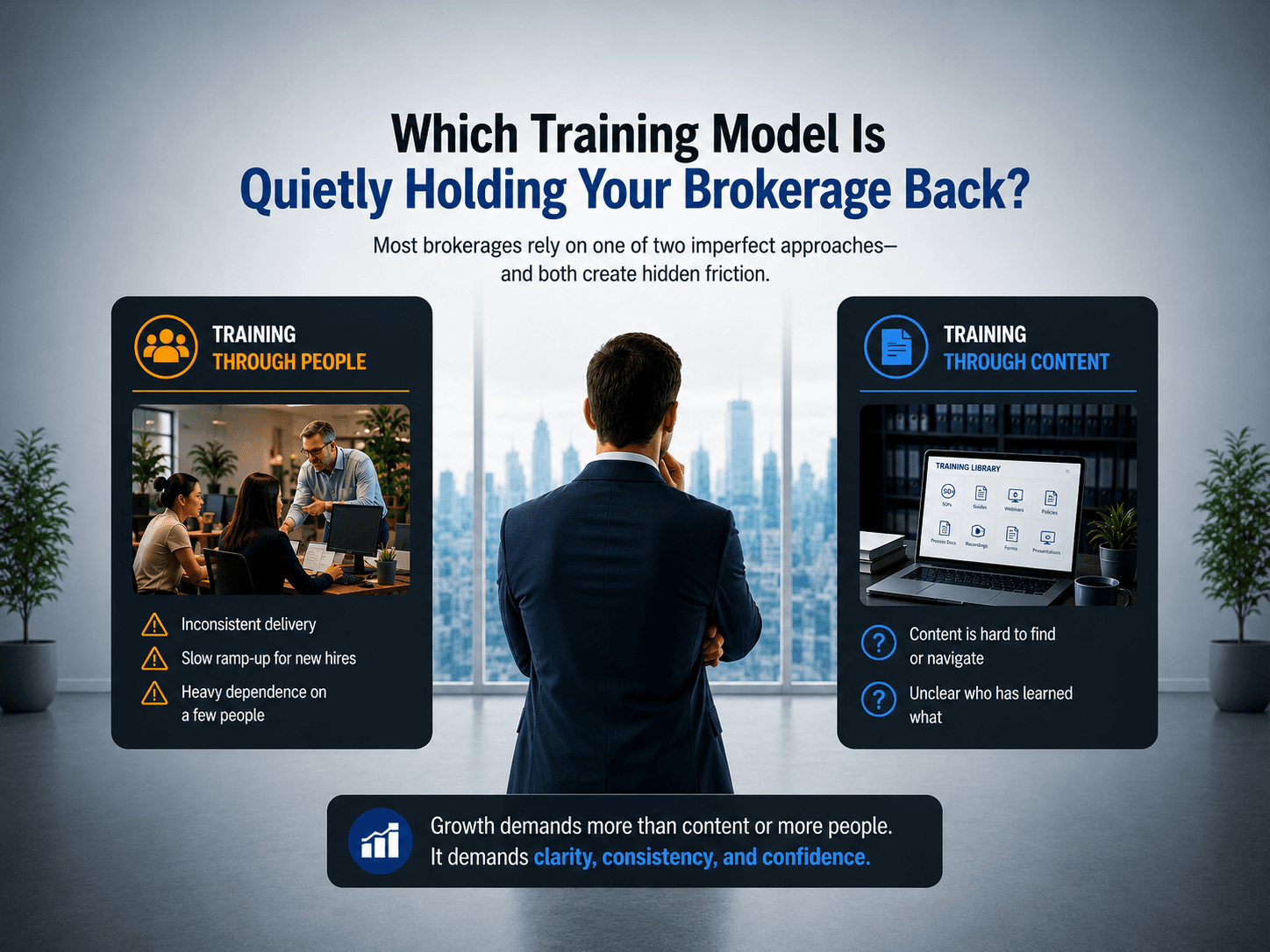
Most brokerages are still operating inside one of two legacy training models — and both begin to break down as the organization grows.
The first model: training through people
In many brokerages, training still depends heavily on human transmission.
Knowledge moves through conversations, shadowing, coaching sessions, team calls, live workshops, and repeated explanations from experienced staff.
This model feels natural because insurance has historically been relationship-driven and experience-based. Senior brokers teach newer brokers. Managers step in when questions arise. Teams rely on the people who "know how things are done here."
At smaller scale, this can work reasonably well.
But as the brokerage grows, the cracks become harder to ignore.
The same experienced people keep getting pulled into the same explanations. Training quality varies depending on who is teaching. Knowledge becomes uneven across locations and teams. Ramp-up speed depends heavily on who a new hire learns from and how much time those people have available.
And eventually, the brokerage becomes operationally dependent on a relatively small number of individuals carrying a disproportionate amount of institutional knowledge.
That dependency creates friction.
Not because those people are failing.
But because human-dependent systems become increasingly difficult to scale consistently.
The hidden cost of the human dependency model
One of the most expensive parts of this model is that the cost rarely appears clearly anywhere.
Senior brokers lose time to repeated interruptions. Managers spend hours filling knowledge gaps reactively. Trainers rebuild or re-explain material that was already delivered before.
The business continues functioning, so the drag often feels manageable.
But over time, the accumulation becomes significant.
Especially in brokerages that are:
- hiring aggressively
- expanding locations
- changing workflows
- onboarding new producers or service teams
- adapting to carrier or regulatory updates
What initially felt like "supporting the team" gradually becomes an ongoing operational tax on the people carrying the knowledge.
And because this model depends so heavily on human availability, training often slows down precisely when the business is growing fastest.
The second model: training through stored content
As brokerages begin feeling the limits of human-dependent training, many move toward the opposite direction.
They begin organizing knowledge into systems.
SOP libraries. Shared drives. Recorded webinars. PDF collections. LMS platforms. Internal portals.
On paper, this appears like progress. And in many ways, it is.
The brokerage now has documented knowledge. Training materials exist in centralized locations. Processes become easier to reference.
But a different problem begins to emerge.
The existence of content does not automatically create operational readiness.
When information exists, but adoption does not
Many brokerages discover that simply storing knowledge does not guarantee that people:
- consume it
- understand it
- apply it consistently
- retain it over time
- follow updated standards correctly
Content may exist in abundance while visibility into actual readiness remains weak.
Leadership may know that materials were uploaded. They may know that sessions occurred. But they often still struggle to answer operational questions with confidence.
Who fully understood the update? Who still needs reinforcement? Which branches are drifting operationally? Where are the actual execution gaps forming?
In many repository-heavy models, knowledge becomes easier to store — but not necessarily easier to operationalize.
And because the content itself now exists, brokerages can mistakenly assume the training problem has been solved when the real issue has simply shifted.
The trap many brokerages quietly fall into
This creates an operational cycle that many brokerages recognize, even if they have never formally described it this way.
When the people-heavy model becomes strained, the organization responds by documenting more content.
But when the content-heavy model fails to create consistency or readiness, teams fall back onto people again.
So the brokerage oscillates between:
- depending on humans
- and
- depending on stored content
without fully resolving the friction underneath either approach.
One model creates dependency drag.
The other creates adoption and visibility drag.
Both create training drag in different ways.
Why this matters more as brokerages grow
At smaller scale, these limitations can remain partially hidden.
But growth amplifies them.
More hires create more training demand. More branches create more consistency risk. More operational complexity creates more update pressure. More movement inside the business creates greater dependency on how quickly knowledge can move across the organization.
And this is often the moment brokerages begin feeling that their existing training model is no longer keeping pace with the speed of the business itself.
Not because people are not trying hard enough.
But because the underlying structure was never designed to scale this way.
The issue is not humans or content
This is important to clarify.
The problem is not trainers. The problem is not SMEs. The problem is not documentation. The problem is not LMS platforms.
All of these can play valuable roles.
The deeper issue is whether knowledge inside the brokerage becomes:
- structured
- repeatable
- visible
- operationalized
- measurable over time
Without those layers, brokerages often remain trapped between two models that both create friction differently.
What changes when training becomes operationalized
When knowledge moves beyond isolated people and beyond passive repositories, training begins functioning differently.
Learning becomes easier to distribute consistently. Updates move faster through the organization. Readiness becomes more visible. Reinforcement becomes more structured instead of reactive. Teams rely less on repeated interruptions and more on accessible, repeatable systems.
The goal is not to remove human support.
Nor is it simply to accumulate more content.
The goal is to reduce the operational drag created by models that struggle to scale knowledge effectively.
A more useful question
Most brokerages eventually ask:
"Do we have enough training?"
But the more revealing question may be:
"Which training model are we actually operating inside today — and where is that model beginning to break down?"
Because once that becomes visible, the conversation changes.
It stops being about whether training matters.
And starts becoming about whether the current model can continue supporting the business at the scale and speed the brokerage now requires.
Closing
Many brokerages are not struggling because they lack effort, good people, or training materials.
They are struggling because the structure underneath their training model still depends too heavily on either people or passive content.
And as the brokerage grows, the friction inside those models compounds quietly in the background.
That is where training drag begins to build.
If your current model still depends heavily on repeated explanations, manual coordination, or difficult-to-measure rollout, hidden training drag may already be accumulating inside the business.
Run the Training Drag Diagnostic and estimate what your current training model may already be costing your brokerage.
https://www.ourbuddy.ai/training-drag-diagnostic
About the Author
Anil Pradhan is the Founder and CEO of OurBuddy.ai. With 20+ years of experience across multiple countries and industries, including Canadian P&C brokerage, customer-facing, technology, and operational leadership roles, he writes about how brokerages can standardize learning, reduce training drag, and build people-development systems that scale.